


shahid
seo analyst
1 July 2026
5 read
Why Pilgrims and Tourists Now Plan One Combined Kashmir Trip
Every year, hundreds of thousands of pilgrims travel to south Kashmir to seek the blessings of Baba Barfani at the Holy Amarnath Cave — one of the most significant Shiva shrines in the Himalayan world. The cave, sitting at an altitude of approximately 3,888 metres, houses a naturally occurring ice shivlinga that waxes and wanes with the lunar cycle, drawing devotees from every corner of India and beyond.
For most travellers coming from outside Jammu & Kashmir, planning an Amarnath Yatra 2026 Kashmir tour means far more than booking the pilgrimage alone. It also means deciding how to fit in Srinagar's houseboats, the world-famous Gulmarg Gondola booking, and day excursions to Sonmarg and Betaab Valley around the trek dates. The good news is that the Pahalgam base camp already sits inside Kashmir's main tourist belt, so the two halves of the trip fit together naturally rather than pulling in different directions.
This guide covers every practical detail you need: the confirmed Amarnath Yatra 2026 dates, the step-by-step registration process, a side-by-side look at the two trekking routes, helicopter options, a ready-to-use 8-day itinerary, packing advice, and the best places to visit in Kashmir to add on either side of the pilgrimage. Whether this is your first Yatra or your fifth, you will leave this page with a clear plan.
Amarnath Yatra 2026 Dates and Registration Process
Getting your Amarnath Yatra registration 2026 sorted early is one of the single biggest factors in how smoothly the rest of the trip comes together. Base camp entry slots, helicopter seats, and even Pahalgam hotel rooms are all allocated around confirmed registration dates — without a valid permit you cannot enter the trek route, full stop.
Registration for the 2026 Yatra opened on April 15, 2026. The official channels are the Shri Amarnathji Shrine Board (SASB) website and the official Yatra mobile app. Offline registration is also available at over 550 designated bank branches across India including SBI, PNB, J&K Bank, Yes Bank, ICICI Bank, and Axis Bank — useful if you prefer to complete the process in person at a branch near your home city.
| 1 | Obtain a Compulsory Health Certificate (CHC) from an authorised doctor, issued on or after April 8, 2026. This is mandatory for every pilgrim including helicopter passengers. |
| 2 | Collect your documents: CHC, a valid Aadhaar card or other government-issued photo ID, and one recent passport-size photograph. |
| 3 | Register online at the official SASB portal (jksasb.nic.in) or the Yatra app, or visit a designated bank branch for offline registration. The fee is ₹150 per pilgrim. |
| 4 | Choose your entry date, route (Pahalgam or Baltal), and batch timing. Groups travelling together can use the Group Registration facility to book as a family or party. |
| 5 | Download your RFID-enabled permit and keep it with you at all times on the trek — it is checked at multiple checkpoints on both routes. |
NRI and foreign national pilgrims register through a separate process on the SASB portal, with an international fee and additional documentation. Eligible age is 13 to 70 years. Women who are more than six weeks pregnant are not permitted to undertake the Yatra.
Pahalgam Route vs Baltal Route — Choosing the Right Path
Both the Pahalgam route Amarnath Yatra that pilgrims have used for generations and the shorter Baltal route Amarnath Yatra lead to the same cave shrine, but they differ enough in distance, terrain, and time commitment that your choice of route shapes the entire shape of your Kashmir trip. The Pahalgam route is the traditional path, passing through some of the most scenically beautiful landscape in the Kashmir Himalayas — the Lidder Valley, the glacial lake at Sheshnag, and the high-altitude meadow of Panchtarni before the final ascent to the cave. The Baltal route is a more recent option, steeper and shorter, suited to pilgrims with limited time or greater fitness who want to complete the trek in a single long day rather than over three to five days.
Whichever path you choose, it sets the pace for the res
t of your Kashmir trip. A five-day Pahalgam trek leaves fewer free days for sightseeing than the faster Baltal route, so plan your Srinagar and Gulmarg days around that difference from the start. If you are visiting Pahalgam as the base for your trek, it is worth spending an extra half-day exploring the town itself — the Betaab Valley, Aru Valley, and Chandanwari are all within easy distance and make the journey feel less rushed.

8-Day Amarnath Yatra 2026 Kashmir Tour Itinerary
Since the Yatra base camps sit inside Kashmir's main tourist belt, most pilgrims now treat the pilgrimage and the sightseeing as one combined trip rather than two separate journeys. A well-paced Yatra-plus-sightseeing trip typically runs seven to nine days depending on which route you take and whether you book a helicopter. The sample plan below uses the Pahalgam route with a helicopter option on Day 4, which frees up two extra days for Gulmarg and Sonmarg. If you are trekking the full Pahalgam route on foot, simply expand Days 4–6 to a five-day trek and push Gulmarg and Sonmarg into a second visit or a longer trip.
|
1
DAY
|
Arrive Srinagar — Dal Lake Houseboat Check-in
Arrive at Sheikh ul-Alam Airport, transfer directly to a Dal Lake houseboat in Srinagar. Rest and acclimatise. An evening Shikara ride on the lake is the perfect way to decompress after a long journey before the intensity of the Yatra begins.
|
|
2
DAY
|
Srinagar Local Sightseeing
Full day exploring Srinagar — Mughal Gardens (Shalimar Bagh, Nishat Bagh, Chashme Shahi), Shankaracharya Temple, and the old city's Jamia Masjid and Shah Hamdan shrine. Read our guide to the top 10 places to visit in Kashmir to make the most of your time in the valley capital.
|
|
3
DAY
|
Srinagar → Pahalgam — Check-in and Rest
Drive to Pahalgam (approx. 2.5 hrs via the Srinagar–Jammu highway). Check into your hotel and rest ahead of the trek. Pahalgam town has good options for a last warm meal and resupplying any trek essentials you may have missed packing.
|
|
4
DAY
|
Yatra Begins — Pahalgam to Panchtarni (Helicopter or Trek)
If you have booked a helicopter booking Amarnath Yatra slot from Panchtarni, transfer by road to the helipad and fly to Panchtarni in the morning, then trek the final stretch to the cave. If trekking in full, Day 4 covers Nunwan base camp to Chandanwari to Sheshnag.
|
|
5
DAY
|
Cave Darshan — Return to Pahalgam
The Darshan at the Holy Amarnath Cave, followed by the return descent via the same route or helicopter, and drive back to Pahalgam or directly to Srinagar depending on your pace and energy levels.
|
|
6
DAY
|
Gulmarg Day Trip — Gondola Ride
Drive from Srinagar to Gulmarg (approx. 2 hrs). Ride the Gulmarg Gondola — Phase 1 to Kongdoori (₹800/adult) and Phase 2 up to Apharwat Peak at 4,200m (₹1,000/adult). Book Gondola tickets in advance during peak Yatra season; they sell out fast. Return to Srinagar by evening.
|
|
7
DAY
|
Sonmarg Excursion
Half-day or full-day trip to Sonmarg — the "meadow of gold" — via the Srinagar–Leh highway. Sonmarg is ideal for a Thajiwas Glacier walk, pony rides, and photography of high alpine meadows before snow arrives later in the season. Return to Srinagar for a final night on the houseboat.
|
|
8
DAY
|
Departure from Srinagar
Last morning at leisure — a final Shikara ride or a visit to the floating vegetable market on Dal Lake — before transfer to the airport. If your flight is in the afternoon, the Srinagar old city and its traditional Kashmiri craft bazaars are worth a final hour of wandering.
|
Best Time and Weather During the Yatra
The Amarnath Yatra 2026 runs through July and August, which is peak monsoon season across most of India but generally moderate and pleasant inside the Kashmir valley itself. Average temperatures in Srinagar during this period sit between 15°C and 30°C — warm enough for comfortable sightseeing, cool enough for the evenings to feel refreshing after a day of walking.
That said, weather along the trek route — especially near Chandanwari, Sheshnag, and Panchtarni — can change very quickly. Sudden rain, fog patches, and occasional landslide risk on both the Pahalgam and Baltal sides are real considerations that every Yatra planning guide has to flag honestly. Most pilgrims planning this kind of combined trip around fixed travel dates build in at least one buffer day, either before the trek or before their return flight, to absorb weather-related delays without disrupting the rest of the itinerary.
SASB and local district authorities issue route advisories in the days leading up to and during the Yatra — the trek can be paused temporarily during heavy rain or landslide warnings, sometimes for 12 to 24 hours. Following these advisories is mandatory, not optional. If you are comparingKashmir vs Manali in summer for weather, Kashmir's valley temperatures are generally more comfortable than Manali for the July–August window.
Kashmir Sightseeing to Pair with Your Yatra
One of the biggest advantages of an Amarnath Yatra 2026 Kashmir tour is that the pilgrimage and the valley's best sightseeing destinations are all within the same travel corridor. You do not need to plan two separate trips to experience both — the right itinerary folds them together seamlessly. Here are the three destinations that every Yatra pilgrim should consider adding on either side of the trek.
If you have never visited Kashmir before and want a broader overview of the valley's highlights before deciding what to add to your Yatra itinerary, our complete guide to the top 10 places to visit in Kashmir walks through every major destination with timing and logistics advice.
Couples combining the Yatra with a honeymoon extension should read our Kashmir honeymoon package guide — it covers the best houseboat categories on Dal Lake, romantic add-ons in Pahalgam and Gulmarg, and how to balance the pilgrimage days with leisure time as a couple. For budget-conscious travellers, our budget Kashmir tour package guide outlines how to keep costs under control without cutting corners on the experiences that matter.
What to Pack for the Pilgrimage and Sightseeing
Packing for a combined Yatra-and-sightseeing trip means managing two different kit requirements in one bag trekking essentials for the high-altitude section and lighter, everyday layers for the valley. The trick is to leave most of your sightseeing clothes at your Srinagar or Pahalgam hotel while on the trek, and only carry what you need on the mountain.
For the Yatra Trek
✓ Original CHC and RFID card — mandatory at every entry checkpoint
✓ Woollens, waterproof rain jacket, and an insulated base layer
✓ Sturdy ankle-support trekking shoes (well broken-in, not new)
✓ Walking stick, torch with spare batteries, and a whistle
✓ Personal medicines, a basic first-aid kit, and altitude sickness tablets
✓ Dry snacks, an electrolyte mix, and a 2-litre water bottle
For Kashmir Sightseeing
✓ Light layers for valley weather (15–30°C in July–August)
✓ Sunscreen, sunglasses, and a brimmed hat for the Gulmarg Gondola
✓ Comfortable walking shoes for Mughal Gardens and Sonmarg meadows
✓ A power bank — charging points are scarce on the trek route
✓ A reusable water bottle and a rain cover for your daypack
✓ A small daypack to leave heavier luggage at the hotel
How Far in Advance Should You Book?
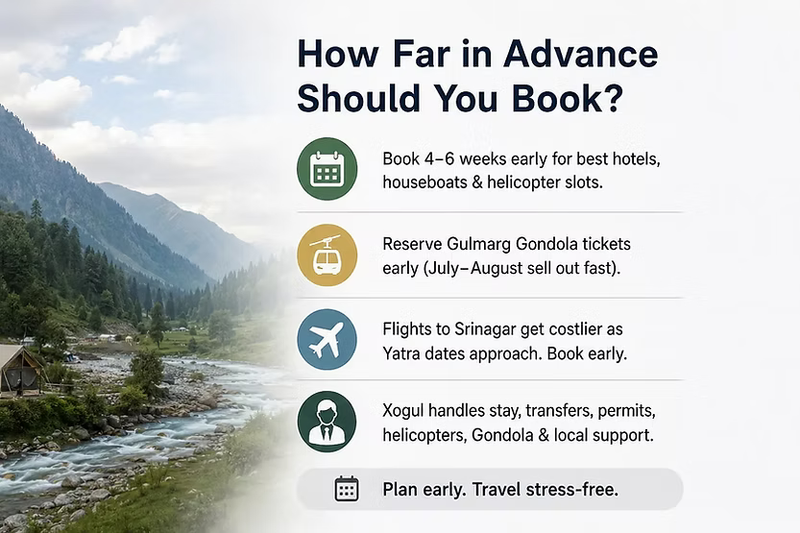
Hotel rooms in Pahalgam and houseboats in Srinagar fill up fastest for the first two and last two weeks of the Yatra — those are peak pilgrimage periods when most people try to travel. Booking your stays and any helicopter slots four to six weeks ahead gives you a far better choice of property category and price than waiting until the month before departure.
If your plans include a Gulmarg or Sonmarg extension, fix those dates at the same time — transport and local guides are easier and cheaper to arrange when the whole trip is booked as one block rather than added on later. Gondola tickets for Gulmarg are especially in demand during July–August; they can sell out days in advance online, so do not leave this to chance.
Flights into Srinagar (Sheikh ul-Alam Airport, SXR) get pricier closer to Yatra dates. The biggest price jumps happen once Yatra registration opens and again in the fortnight before the trek starts. Locking in air travel at the same time as registration is the most cost-effective approach. If you are comparing destinations and still on the fence, our Kashmir vs Kerala guide lays out the differences clearly for summer travel in 2026.
As a Srinagar-based travel agency, Xogul handles the logistics that are hardest to coordinate from outside the valley — base camp transfers, Pahalgam and Srinagar hotel stays, Gondola bookings, helicopter slot co-ordination, and local route guidance during the Yatra itself. Our approach as one of the best travel agencies in Kashmir is to treat each itinerary as a single logistics puzzle, not a set of separately booked pieces
More from the Xogul Kashmir Travel Magazine
Conclusion
Planning the Amarnath Yatra 2026 is much easier when you arrange the essentials well in advance. From registration and accommodation to helicopter bookings and local transport, early planning helps you secure better availability, lower costs, and a smoother pilgrimage experience. Whether you choose the traditional Pahalgam route or the shorter Baltal route, combining the Yatra with a few days in Srinagar, Gulmarg, or Sonmarg can make your Kashmir trip even more memorable. With the right preparation, the Amarnath Yatra becomes not just a spiritual journey, but a comfortable and rewarding travel experience through some of the most beautiful landscapes in the Himalayas.
Plan Your Amarnath Yatra 2026 with Xogul
As a Srinagar-based agency, we handle the logistics that are hardest to coordinate from outside the valley — base camp transfers, Pahalgam and Srinagar hotel stays, Gondola bookings, helicopter slots, and local route guidance throughout the Yatra. Get a custom itinerary built around your dates, route, and sightseeing preferences.
Frequently Asked Questions
When does Amarnath Yatra 2026 start and end?
Amarnath Yatra 2026 will run from 3 July to 28 August 2026.
Is Amarnath Yatra 2026 registration still open?
Registration opened on 15 April 2026. Check the official registration portal for current slot availability.
Which route is easier: Pahalgam or Baltal?
Baltal Route: Shorter (1–2 days) but steeper and more challenging.
Pahalgam Route: Longer (3–5 days) but more gradual and comfortable for most pilgrims.
Can I combine the Yatra with Kashmir sightseeing?
Yes. Many pilgrims add Srinagar, Gulmarg, Sonmarg, or Pahalgam to their itinerary before or after the Yatra.
Is a health certificate required for helicopter pilgrims?
Yes. A valid Compulsory Health Certificate (CHC) is required for all pilgrims, including helicopter passengers.
How much does a Gulmarg Gondola ticket cost in 2026?
Phase 1 (Gulmarg to Kongdoori): ₹800 per adult
Phase 2 (Kongdoori to Apharwat): ₹1,000 per adult
Combined ticket: ₹1,800 per adult